Quick start · page 3 of 29
Quick start: a web app with Next.js
In 30 seconds
- You need a GitHub account, a key for the agent, and GitHub Actions minutes. A Vercel account too, if you want a running copy to open.
- You do: make the repository from the template, add the key, and wait while Lay the foundation builds on your CI. Then give your look.
- You get DoneMark № 1.
Nothing exists yet, and you want a web app. The template Web app · Next.js with Postgres gives you a repository DoneMark can read from its first commit, and a first ask already written and approved: Lay the foundation. DoneMark's agent builds it on your CI, and you judge it.
Before you start
- A GitHub account.
- A key for the agent: a Claude Code token, made with
claude setup-tokenin a terminal on a machine with a Claude subscription, or an API key from console.anthropic.com with credit on it. - GitHub Actions minutes. Each attempt runs on your CI, with your key.
- A Vercel account, if you want to open a running copy of each attempt. It is optional, and recommended for a Next.js app.
The steps
- Sign in with GitHub and name your organisation.
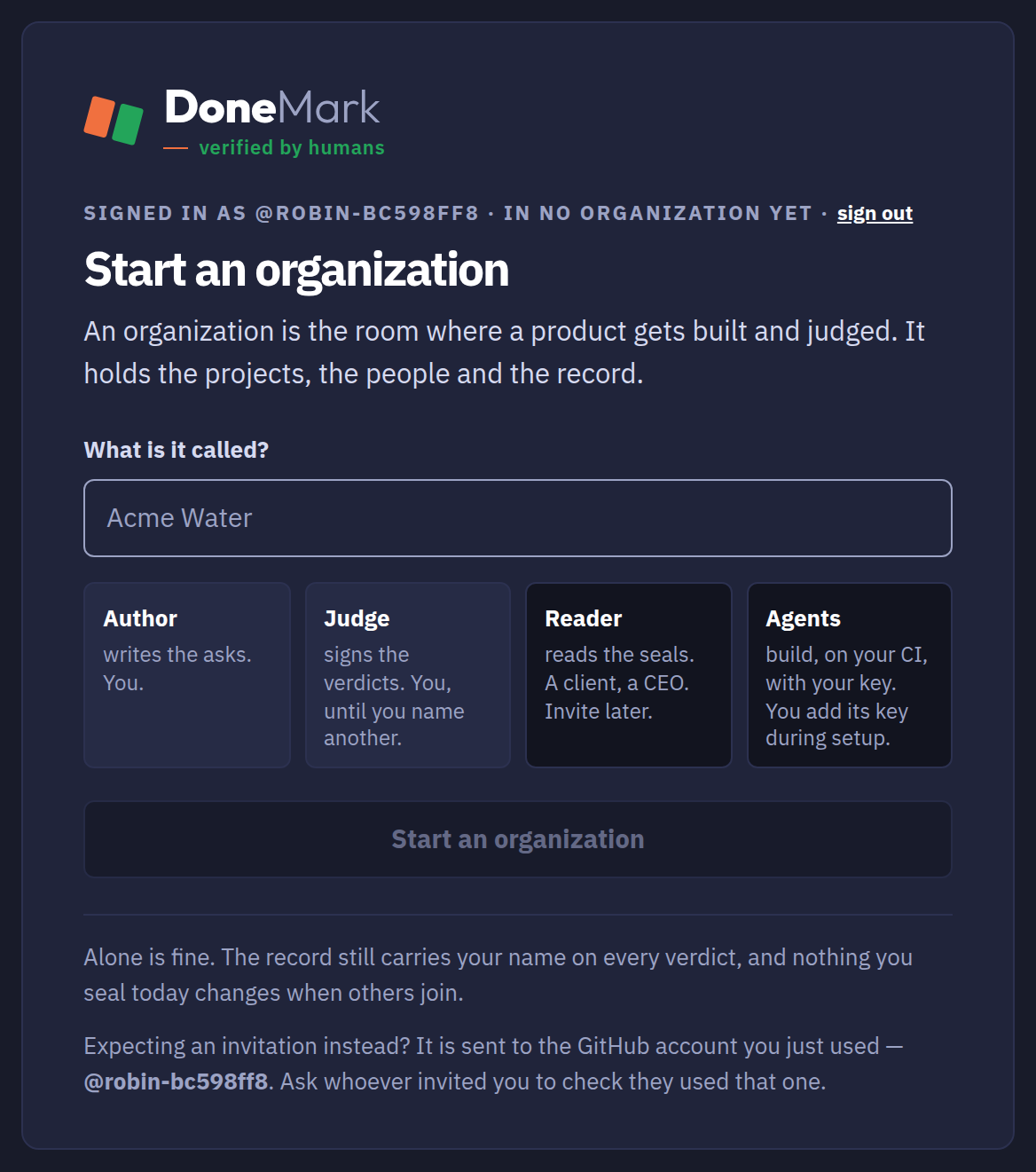
Start an organization: one name, and the four seats under it. - New project → A new app, from a template → Continue with a template, and choose Web app · Next.js with Postgres.
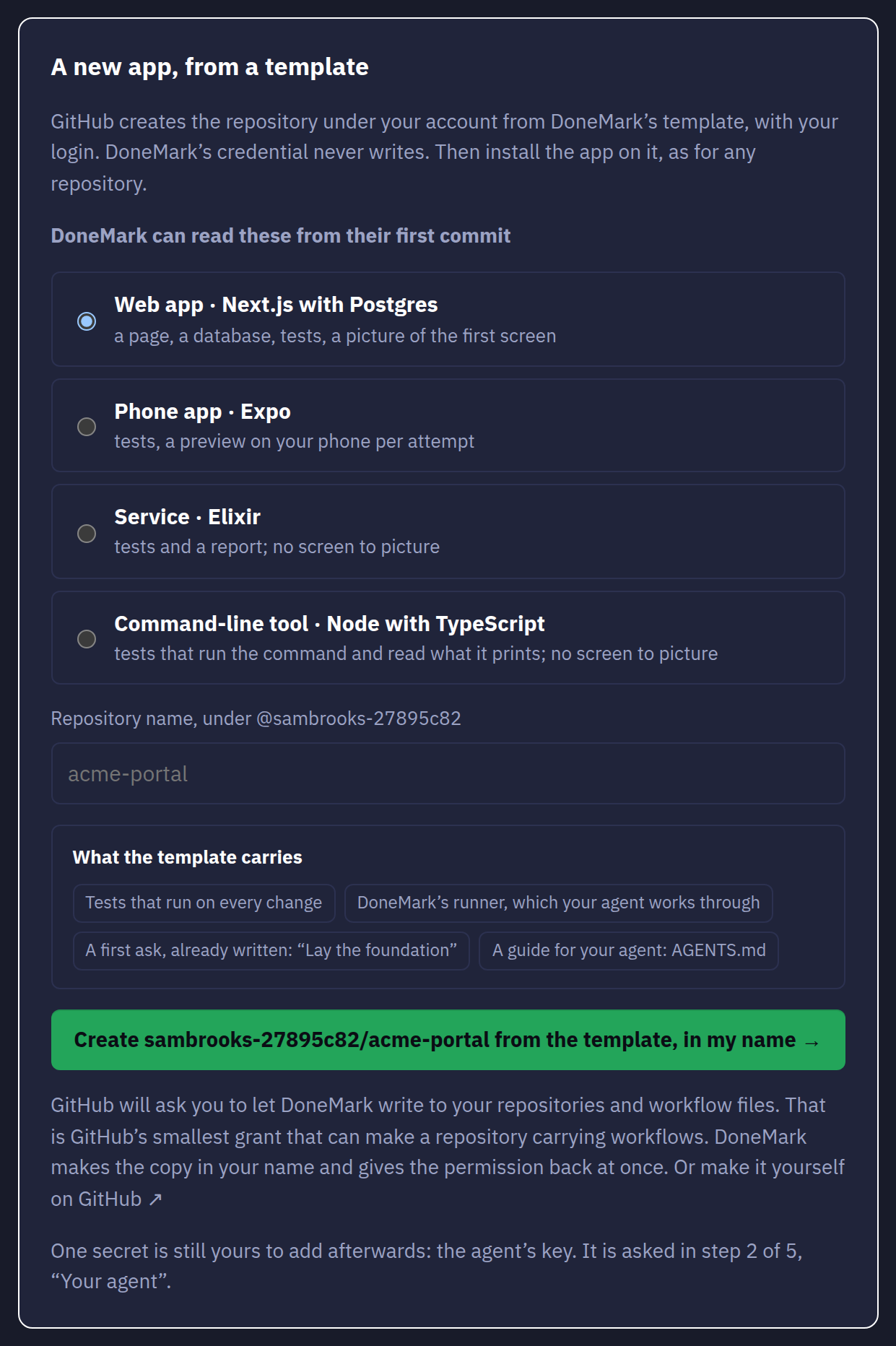
The templates; the button under them makes the repository from the template, in your name. - Make the repository. Press Create owner/name from the template, in my name →, or make it yourself on GitHub. The copy is yours, under your account. If the page asks, give DoneMark witness the new repository.
- Add the agent's key. Paste it and press Seal it and store it on GitHub, in my name →: your browser seals it before it leaves the page, and GitHub keeps it as a secret of your repository. DoneMark records its name, never its value. Then press Test the key.

Your agent’s key, as your runner answered when it was tested. - Wait for the first build. Lay the foundation builds by itself once the test run passes. Its done when lines name checks the template already carries: a fresh copy installs and its tests pass, the app starts and shows its name on its first screen, with a picture, and DoneMark reads the repository as ready.
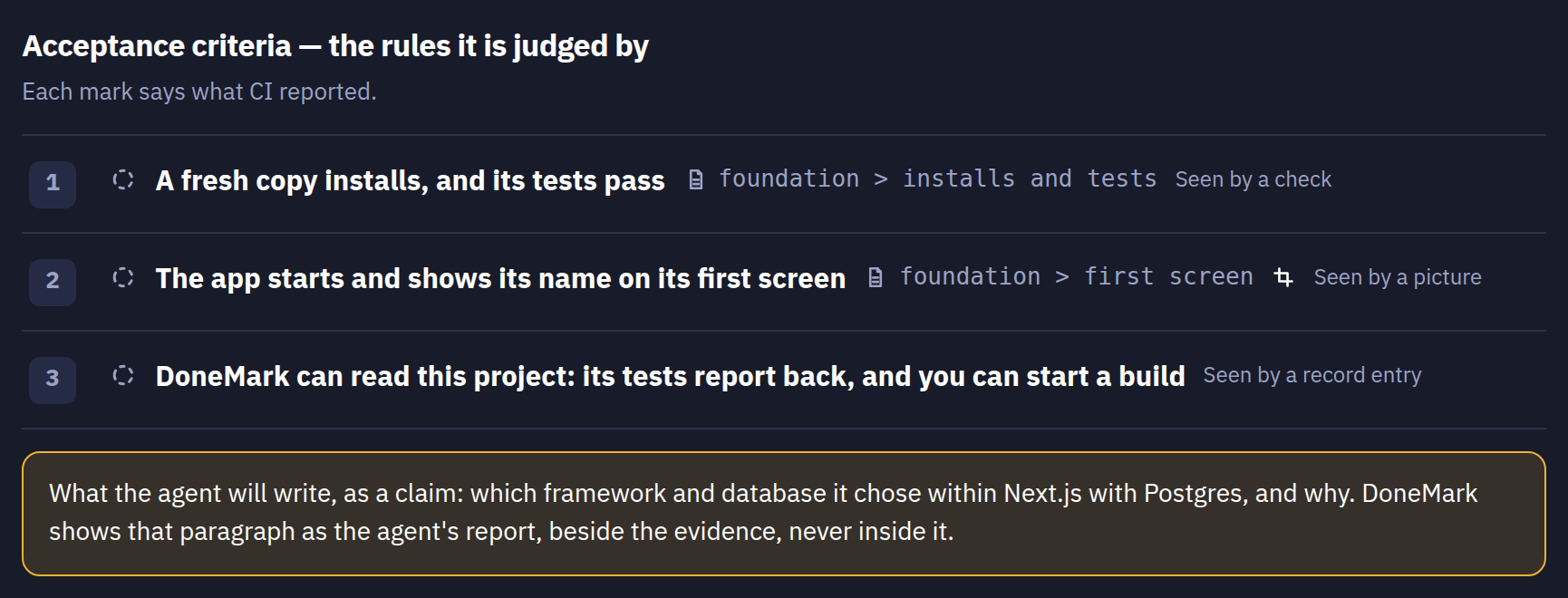
Lay the foundation: three done when lines, and the checks the template already carries. - Give your look. When the evidence has settled, the page opens and DoneMark emails you. Read each line beside what was seen. With Vercel set up (see below), the run page shows A copy of this build is running: Open it ↗ and try it. Then press Looks right or Not quite, with a reason.
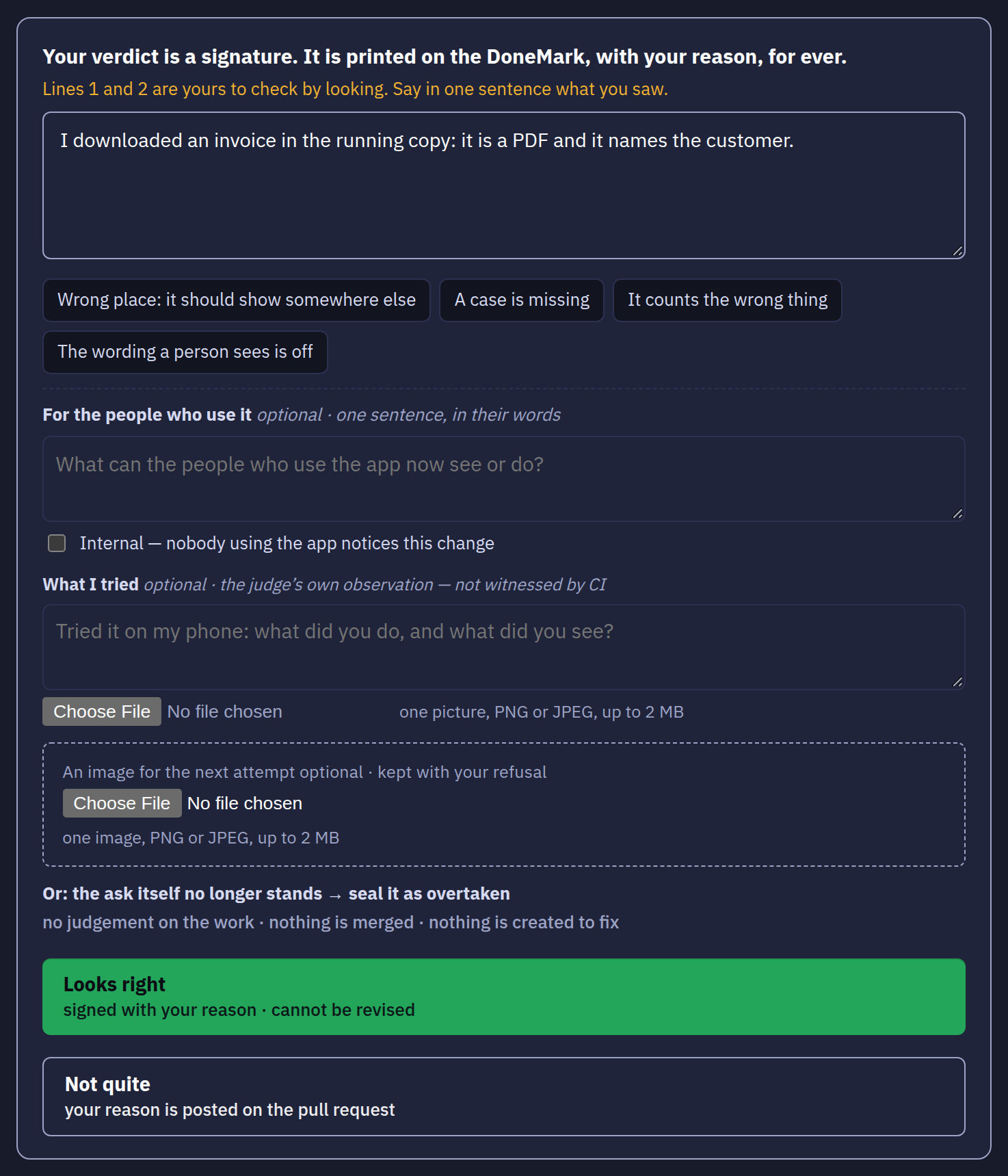
A reason in your own words, then Looks right or Not quite. - Seal the one and put it live, on its release. It is the project's first sealed record, DoneMark № 1.
Good to know
- For a running copy of each attempt, import the new repository on Vercel, on Vercel's own site and with your own login: Vercel then builds a preview for every pull request. Choose Vercel under How does it go live? → Where it runs, and DoneMark finds the preview built from each attempt's commit. Without it, step 6 has no copy to open, and you judge on the evidence alone.
- Vercel is also what lets a done when line be seen by a journey: your CI walks a person's path through the running copy and photographs every step.
- What the agent chooses inside the stack, such as which libraries, is written as its own claim and shown beside the evidence, never inside it.
Next
- Start a new app, in full.
- Seeing it running: the running copy, the database warning and journeys.
- The loop, step by step: every ask after the first.